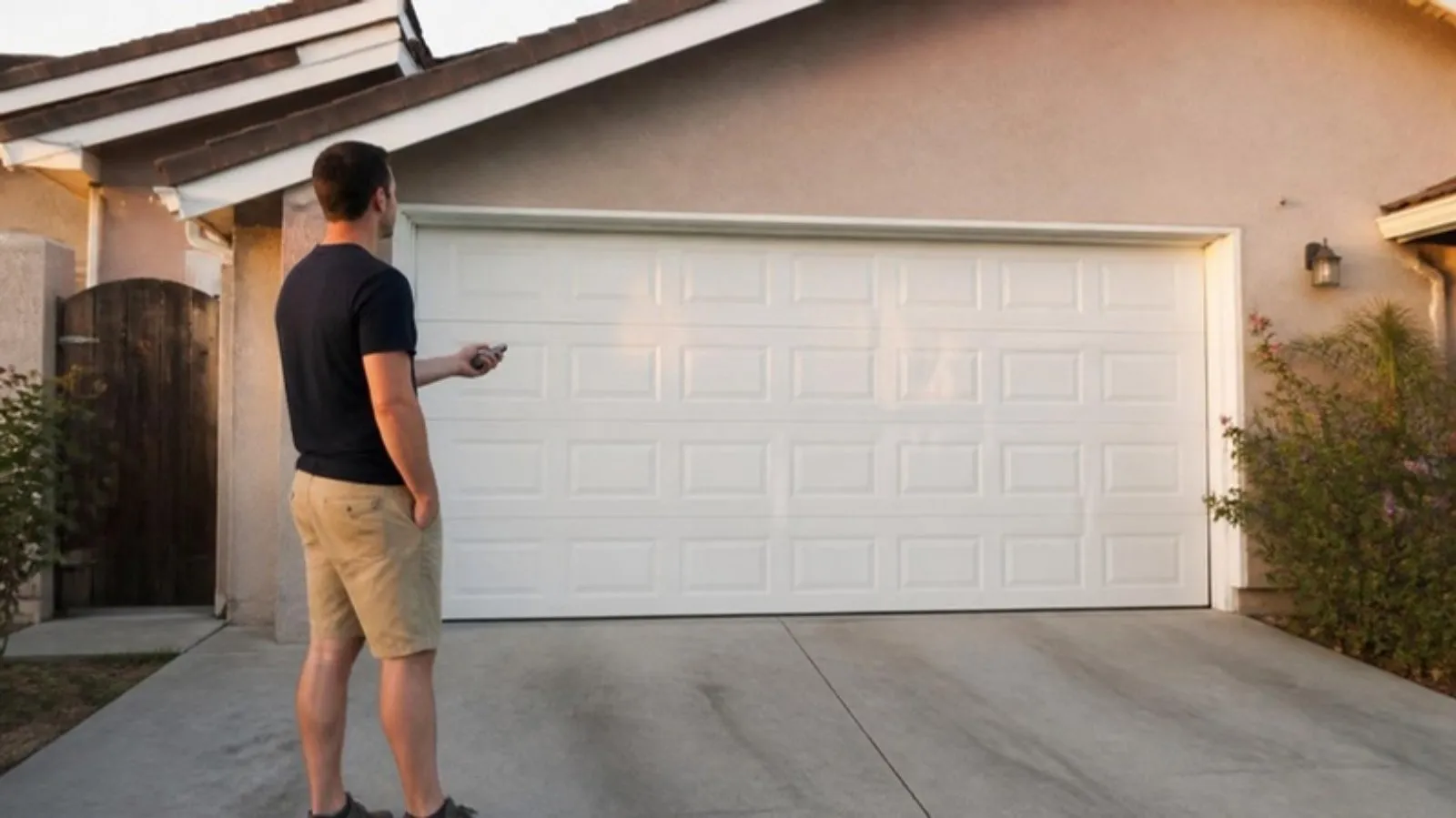
If your garage door won’t open, check five things before you call anyone: power to the opener, the wall button versus the remote, the lock on the wall console, the door’s own slide lock, and the red release cord. If the motor hums but the door stays down, or the door feels far too heavy to lift by hand, a spring has probably broken. Stop there and call a technician.
We’re All Access Garage Doors, and we handle garage door repair for homes across San Diego County. “My garage door won’t open” is one of the calls we hear most often. Some causes take five minutes to check with no tools. Others involve springs, cables or the opener’s drive gear, and those need a trained tech. The checks below go from easiest to most serious.
Is the opener getting power?
If the opener’s light stays dark and the motor makes no sound, the opener has no power. Look up at the ceiling outlet first: plugs work loose from vibration. Then check for a tripped GFCI outlet in the garage (press its reset button) and a tripped breaker in your panel. To test the outlet, plug in a lamp or phone charger.
Does the wall button work when the remote doesn’t?
Press the wall button. If the door opens, the problem sits with your remote. Swap the remote’s battery first. If that fails, reprogram the remote using the “learn” button on the opener head; your opener’s manual lists the steps for your model. If neither the wall button nor the remote does anything but the light comes on, move to the next check.
Is the lock or vacation mode switched on?
Many wall consoles, including most LiftMaster and Chamberlain models, have a lock button that shuts off every remote while leaving the wall button working. A blinking light on the console often means lock mode is on. On many models you turn it off by holding the lock button for a couple of seconds. Check your manual to be sure.
Is the door’s own slide lock engaged?
Some garage doors have a manual lock: a handle or bar on the inside of the door that slides into the track. If someone locked it, the opener will strain and stop. Slide the bar back and try again. If your opener strained hard against a locked door, watch it for the next few cycles in case it damaged the drive.
Is the door still connected to the opener?
If the motor runs but the door doesn’t move, the opener may have come unhooked from the door. That happens when someone pulls the red emergency release cord. With the door fully closed, run the opener once; on most models the trolley clicks back into place on its own. If the motor runs and the trolley moves but the door doesn’t, the problem lies in the door itself, most often a spring.
Could a broken spring be the cause?
Yes, and it is the most common serious reason a door won’t open. Springs carry nearly all of the door’s weight. The opener only guides it. When a spring breaks, the opener can’t lift the door, or it lifts a few inches and stops. Watch for these signs:
- You heard a loud bang from the garage, like a gunshot
- You can see a gap in the coiled spring on the bar above the door
- The door rises a few inches and stops, or goes up crooked
- The door feels too heavy to lift by hand
Most torsion springs are rated for about 10,000 open-and-close cycles. Use the door three or four times a day and you reach that in roughly 7 to 9 years, so if your springs are original to a door that age, a break is likely. Read more in our guide to the signs of a broken garage door spring, or go straight to our broken spring repair page.
Could it be the cables or tracks?
A snapped lift cable or a door that has jumped its track will also stop a door from opening. Look along both sides of the door. A cable hanging loose, a roller sitting outside the track, or a door that hangs crooked all point here. Leave the door where it is. Cables and springs work as one system under heavy tension, and moving the door can make the damage worse.
Are the safety sensors to blame?
Usually not, if your problem is opening. The two small photo-eye sensors near the floor stop the door from closing on a person, pet or car. The UL 325 safety standard has required them on openers made since 1992. On most openers they don’t block the door from going up. If your door opens fine but won’t close, clean and realign the sensors first.
What should you not do?
- Don’t pull the red release cord while the door is open. If a spring is broken, the door can drop.
- Don’t try to lift a door that feels heavy. The spring is no longer helping you.
- Don’t loosen, adjust or wind springs or cables yourself. Torsion springs store enough energy to cause serious injury.
- Don’t keep pressing the button while the motor strains. You can strip the opener’s drive gear and turn a spring repair into an opener replacement too.
- Don’t use your car to push or pull the door.
When should you call a technician?
Call a pro if any of these apply:
- The door won’t lift by hand, or lifts only a few inches
- You can see a gap in a spring or a loose cable
- The door hangs crooked or a roller has left the track
- The motor hums or runs and the door still won’t move after you reconnect it
- Your car is stuck inside and you need it today
Getting your garage door fixed in San Diego County
All Access Garage Doors repairs springs, cables, tracks and openers for homeowners from Oceanside and Carlsbad down to Chula Vista, and inland to El Cajon, Santee and Poway. You get a written quote before we start any work. Call (833) 537-1818 or book a repair online. If your door is stuck open and your home isn’t secure, see our emergency garage door repair page. For opener-only problems, see garage door opener repair.
Frequently asked questions
The opener has power, so the problem sits between the opener and the door. Check the console lock, the door’s manual slide lock, and whether the release cord has disconnected the trolley. If the motor runs and the door still won’t move, a broken spring is the most likely cause.
You shouldn’t. With a broken spring, you or the opener would be lifting the door’s full weight, which the spring normally carries. The door can also drop without warning. Leave it closed and call a technician to replace the spring.
With the door fully closed, pull the red emergency release cord to disconnect the door from the opener, then lift the door by hand. It should rise smoothly and stay put halfway. If it feels heavy or drops, stop: a spring may be broken.
The opener’s safety system reverses or stops the door when it senses too much resistance. A broken spring is the most common cause. A locked slide bar, a bent track or a frayed cable can do it too. Don’t keep retrying, because each attempt strains the opener.
The remote has a dead battery, has lost its programming, or the console’s lock mode is on. Replace the battery, check for a blinking lock light on the wall console, and reprogram the remote using the opener’s learn button if needed.